


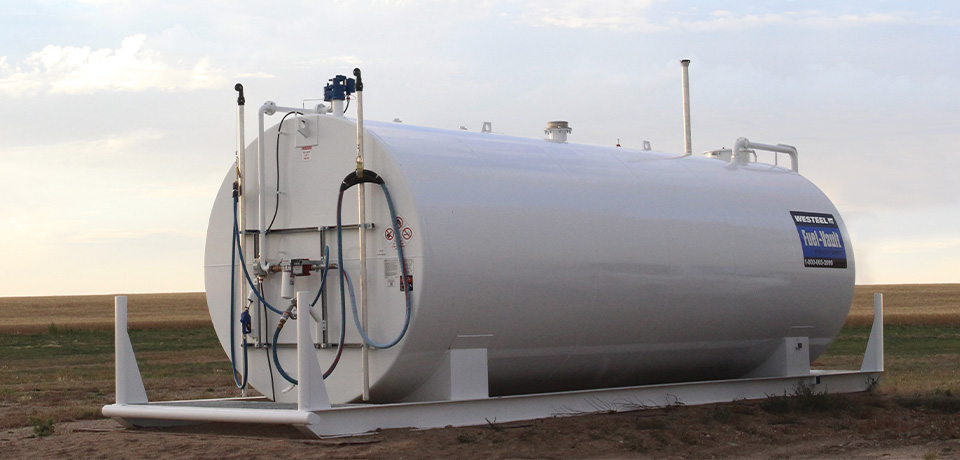
With the 2023 seeding season rapidly approaching, it’s time to think about your fuel tanks.
Some farms still have raised above-ground fuel tanks. While legal, these tanks are dangerous, presenting a liability to the operation. The unknown condition and integrity of the tank stands present an added risk to the farmer and the fuel supplier. Even a simple refill requires that the fuel supplier climb the ladder while carrying a hose and that they remain balanced on the ladder while the tank fills.
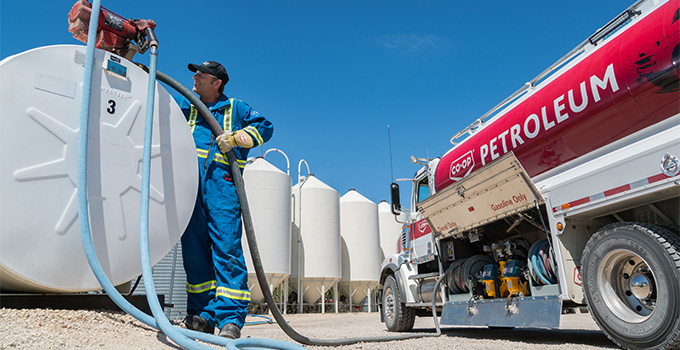
With these considerations in mind, it should be easy to make updating your fuel storage a high priority.
Considerations for Safer Fuel Storage Systems
-
Tank Specifications
Safe regulated fuel storage starts with purchasing tanks approved by either Underwriters Laboratories of Canada (ULC) for stationary storage systems or Transport Canada for mobile (slip) storage systems. These standards ensure that storage systems are able to handle the tough weather conditions of Western Canada and include features such as dual-wall tank systems, industrial-grade external protective coatings and innovative ventilation and filtration systems.
-
Single-Wall vs. Double-Wall Tanks
Old, single-wall gravity tanks and tanks on stands are not only at high risk for corrosion-related failure, but they are also dangerous to fill. They generally lack a shut-off mechanism at the outlet in case of an accident or leak.
“When choosing between new single-wall and double-wall tanks, your fuel-tank site will be an important consideration,” said Brandy Nelson, Petroleum Manager at Lloydminster Co-op. “Single-wall, on-ground tanks need to be located within a concrete containment wall to contain fuel spills. This means extra work, and will reduce the portability of the tank.” Nelson added that the containment wall itself will need to be maintained and drained after rain, to ensure it is capable of carrying the fuel tank’s capacity in case of a spill. A pump will be needed to dispense fuel, with access to a 12V or 240V power source.
New ground tanks are all dual-wall, self-contained tanks, with safety measures in place to contain tank leaks or punctures. Double-wall tanks situated on the ground are also safer for fuel delivery personnel to fill, with less potential for slips, falls or back strain.
“Double-wall tanks offer reinforced protection that will help prevent leakage or spillage,” said Nelson. “Being on the ground means that tanks are also less likely to be tipped or blown over, causing environmental damage.”
-
Site Requirements
Selecting an appropriate fuel-tank site is essential. Tank site plans should include a strategy to slope the foundation or tank itself to the fill end to allow for inspection and water removal. Poor site management can result in soil and water contamination, expensive cleanup costs, decreased property value and the potential need for site evacuation.
For applications involving emergency generators, fuel polishing (cleaning or replacing fuel regularly) is required due to fuel being stored for long periods of time. A dual-wall fuel tank is the best option for protection from internal corrosion and potentially costly fuel spills. If corrosion results in a breach of the internal wall, the outer wall will prevent fuel release.
After choosing a fuel tank site that meets regulatory compliance standards, you should regularly inspect and maintain the tank.
-
Regulatory Requirements
Provincially, Manitoba is the only province that regulates farm-fuel storage and requires a tank permit, unless the capacity of the tank is less than 5,000 litres. At this time, Alberta and Saskatchewan do not regulate farm-fuel storage practices and permits are not required.
Get Expert Advice at Your Local Co-op
Fuel tank options are as varied as the farms they serve.
Typically, as your operation grows in size, so will your fuel storage requirements. As a rule, you should aim to have enough fuel on hand to last you four to five days during your peak seasons. This will allow you to manage your fuel inventory and allow for a safety margin between deliveries.
Whether you’ve outgrown your available fuel storage, have noticed dents or rust in your tanks, or are still using gravity-fed tanks, your local Equip Team members can help you navigate the many decisions that go into choosing the right tank for your needs.