


Every year, portions of prairie fields are consumed by cutworms.
Their damage tends to be sneaky - undetectable one day, then huge patches of missing crop the next. They typically feed at night, going unnoticed during the day.
Knowing the predominant species of cutworm and how to scout for them is an essential first step to protect — or save — your crop.
Life cycle
Cutworms are most active from late April and early May into July. Their growth rate depends on heat accumulation, so the warmer it is, the faster they mature, increasing the potential for greater damage from feeding. In July, larvae burrow into the soil, pupate, and later emerge as adult moths. When laying eggs, adult moths are attracted to loose soils, like pea and lentil stubble.
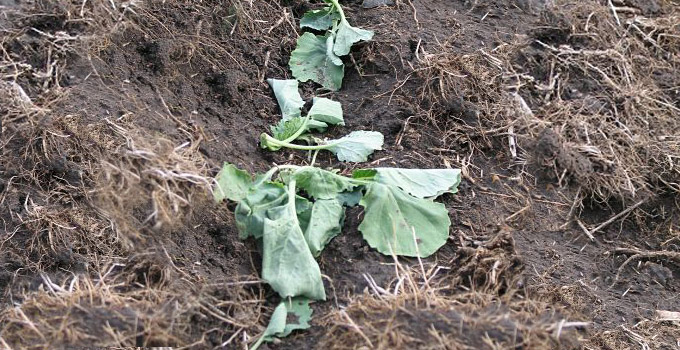
Photo source: Canola Council of Canada
Scouting
Scouting should start early in May and continue every three to four days until mid-July. Bare patches in the field are a clue, typically appearing on south facing slopes and hilltops, where the soil is warmer. Larvae are commonly inactive during the heat of the day, preferring to feed at night and sometimes on cool, overcast days. Occasionally cutworms are found right near the plant they’ve just damaged, and typically curl up when disturbed.
Using a quarter meter squared frame, check the top 2.5 cm of soil for larvae (use a trowel to carefully scrap away soil) and multiply the number by four for a full square metre count.
Control options
Growers have more options to control cutworms than ever before. For example, if growers know cutworms are present, they can proactively choose Lumiderm™ or Fortenza® seed treatment for their canola. Once a crop is up, there are several foliar insecticide options, including Coragen®, Pounce®, Matador® and chlorpyrifos (Lorsban®, Citadel® and Nufos®).
Coragen introduces a new insecticide group to Western Canada where the primary mode of action is ingestion rather than contact. It’s effective and broad spectrum and easier on bees and beneficial insects. (Note: Coragen should not be applied following a Lumiderm or Fortenza seed treatment.)
Fortunately, the cutworm population can sometimes be partly controlled by beneficial insect parasites and predators. Their population can be reduced even more in wet years by deadly fungal diseases.
For guidance on cutworm presence, severity and control decisions, contact your local AG Team Agronomist.
Know your cutworms
While cutworms are difficult to identify, there are clues growers can look for to help them distinguish between species, including when and where they appear and how they’re feeding. Identifying the species is key to determining control options and economic thresholds.
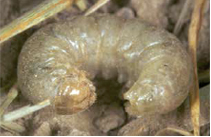
Name: Redbacked
Location: Parkland and northern prairies
Identification: Reddish-brown stripes extending down the back with a darker line in the middle; 38 mm as full-grown larva (f.g.l.)
Host crops: Cereals, flax, canola, corn, mustard, sunflower and many other crops
Feeding damage: Young larvae chew holes in leaves; older larvae sever stems at or below surface
Overwinters: Eggs
Economic threshold: 5 - 6 larvae/m2
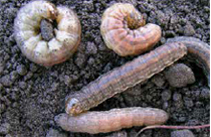
Location: Southwest and central prairies
Identification: Grayish-white to green; lacking any distinguishing marks; up to 40 mm long as f.g.l.
Host crops: Cereals (wheat preferred), canola, mustard, flax, corn, legumes, certain weeds
Feeding damage: Larvae feed below ground; leaf holes appear as leaf emerges; plants cut at or below soil surface
Overwinters: Eggs
Economic threshold: 3 - 4 larvae/m2
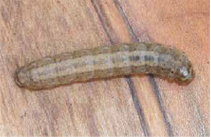
Name: Army
Location: Western prairies
Identification: Pale greenish-grey to brown with a pale-striped back; finely mottled; 37 - 44 mm as f.g.l.
Host crops: Wheat, oats, barley, canola, mustard, flax, alfalfa, peas, weeds, grasses
Feeding damage: Entirely above ground; larvae feed in the late afternoon to early evening
Overwinters: Larvae
Economic threshold: 5 - 6 larvae/m2
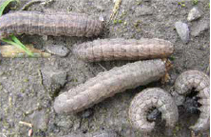
Name: Dingy
Location: Eastern prairies
Identification: Broad gray stripe with light gray v-shaped patterns, and four black dots on each segment; 25 - 32mm as f.g.l.
Host crops: Sunflowers, alfalfa, corn, flax, canola, oats, barley, rye, wheat, grass, weeds
Feeding damage: Leaf feeders, rarely cut plants
Overwinters: Larvae
Economic threshold: Cereals: 3 - 4 larvae/m2; oilseeds: 25 - 30 per cent stand reductions; peas: 2 - 3 larvae/m2
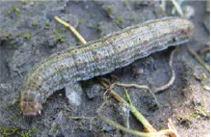
Location: Often found with redbacked
Identification: Dull-coloured with shiny heads and a white stripe along body. Up to 37 mm long at maturity
Host crops: Cereals, canola, corn, flax, sunflower
Feeding damage: Feeds on leaves and stems of young plants
Overwinters: Eggs
Economic threshold: 5 - 6 larvae/m2
Photo source: AAFC, Field Crop and Forage Pests and their Natural Enemies in Western Canada

Knowledge & Innovation Manager