


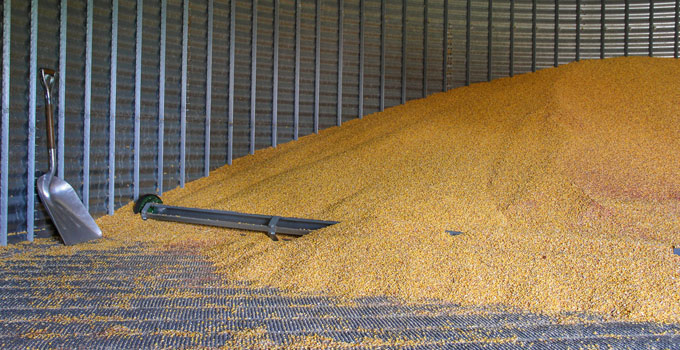
Temperature and moisture are two of the biggest concerns growers have once their grain enters the bin.
However, producers have several tools to prepare and condition grain for long-term storage, including:
- Heated air drying systems
- Natural air grain drying fans
- Aeration fans
Heated air drying systems are the easiest and most effective way to reduce the moisture content of grain and avoid spoilage, but they come at the greatest cost.
To properly prepare grain using less expensive natural air-drying and aeration fans, growers need to know their equipment and environment.
“The most common mistake is not understanding that natural air drying requires sufficient airflow rate,” said Joy Agnew, Project Manager – Agricultural Research Services with the Prairie Agriculture Machinery Institute (PAMI). “A fan sized and selected for aeration will not generate a high enough airflow rate to actually result in moisture removal.”
Aeration vs. natural air drying
Aeration fans are used to cool and condition the seed, while more powerful natural air drying fans are used to reduce moisture content.
| Aeration |
|
| Natural air drying |
|
Source: PAMI, Facts about Grain Aeration
“The goal of aeration is to cool grain, so run the fans whenever the ambient air is cooler than the grain,” said Agnew. “If the airflow rate is less than 0.25 cfm/bu (cubic feet of air per minute per bushel), then aeration generally does not affect moisture.”
Optimizing natural air drying results
Natural air drying can be used to add or remove moisture. To do so effectively, growers must understand how outside conditions will influence the grain inside the bin. Before they turn fans on, growers should consider:
- Air temperature and relative humidity outside the bin.
- Grain type, temperature and moisture content.
- Airflow rate.

PAMI helps growers interpret these conditions with equilibrium moisture content (EMC) charts. By using the outside temperature and relative humidity, growers can see how they can influence the moisture content of their grain through natural air drying. Charts for wheat, barley, peas, oats and canola are available on PAMI’s website. However, these charts are to be used only as a guideline, as the EMC values haven’t been validated for newer crop varieties.
“The ability to dry grain with natural air drying relies on Mother Nature and she doesn’t always co-operate,” said Agnew. “The general recommendation, and easiest to implement, is to turn the fans on when the grain covers the ducting and let the fan run continuously until the grain at the top is dry.
“However, there are several control systems that are commercially available that will automatically turn the fan on and off when ambient conditions are most favourable.”