



When it comes to fusarium head blight, timing is everything.
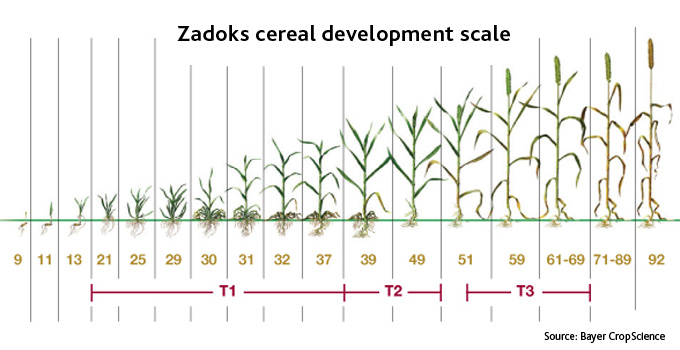
While a fungicide applied at flag leaf timing will benefit wheat growers, those who closely monitor their crop’s growth and can delay spraying until head timing will see the greatest return on their investment.
In field-scale trials conducted over the last eight years, Bayer CropScience has found the best yield and crop quality results come from fungicide applications at head timing or when the first flowers are visible on the head. Flowering usually occurs about three days after the head is fully emerged, at which time the first anthers are visible.
“There used to be a school of thought where you’d just want to protect the flag leaf,” said Cal Lutz with Prairie Co-op in Lipton, Saskatchewan. “That’s a good thought if you actually see disease moving up the plant, but if that disease isn’t present and you can wait to do your fungicide application, one application at head timing will do the best job on fusarium head blight and still protect your flag leaf.”
Farm smarter
Low disease levels at flag leaf timing usually allow growers to wait for a later application.
However, if disease pressure is high and you have to spray early, consider two applications to ensure maximum protection for yield and grain quality. Use a flag leaf-targeted fungicide first with a second application of a fusarium head blight fungicide at head timing.
In order to manage fusarium head blight, an integrated approach, which also incorporates crop rotation, variety selection and good management, will deliver the best results. To get the most of your fungicide applications, Troy Basaraba of Bayer CropScience recommends the following management tips:
- Increase seeding rate: A uniform crop helps make staging a head-timing fungicide application easier. Increasing seeding rate can mitigate variability in crop staging by increasing the number of plants and reducing the amount of tillers.
- Nozzle selection: A nozzle design with a spray pattern angled to both the front and back will cover both sides of the head and perform better than a single vertical pattern.
- Boom height: Given the spray angle of forward/backward nozzle designs, the boom should be 12 to 15 inches from the top of the crop canopy, ensuring droplets hit the targeted head within the 20-inch spray pattern recommended by nozzle manufacturers.
- Maintain high water volumes: Cutting water volumes can lead to poor coverage on the head. The minimum recommended water volume is 10 gallons per acre, although many growers are now using 15 gallons per acre.
- Droplet size and pressure: Growers should target a medium to coarse droplet size. While a fine droplet size can give excellent coverage, they are very susceptible to wind shear and drift, which can cause the droplets to miss their intended target. Extra coarse or very coarse droplets, while less prone to the effects of wind, do not provide sufficient coverage of the cereal head.
- Speed: There is no hard and fast rule for what the maximum travel speed should be. Consult the nozzle application charts available from manufacturers to understand the effect of speed on pressure and droplet size.
Bigger, better crops
“If you can get as much product as you can on all sides of the wheat head, then you’re doing your best to protect that head,” said Lutz, who noted many growers see increased test weights following a head fungicide application, even when disease pressure is low.
“There always is some level of disease. Even if you can save one grade, the economic benefit of doing it is there.”
For more information about maximizing your fungicide applications, talk to your local Co-op AG Team Agronomist and visit itpaystospray.ca.

Prairie Co-op