


A successful crop begins with early weed removal — so when weeds get stronger, farmers must get smarter.
The pre-seed tank mix strategy — which mixes glyphosate, the popular Group 9 herbicide — with another effective product with a different mode of action, gives growers better control of the competitive weeds that affect crop growth early in the season.
It also helps producers slow the spread of herbicide-resistant weeds and protect the utility of glyphosate, their most important herbicide.
Southern Alberta responds
“We’re not a single-product strategy anymore for any of our crops,” said Elan Noga, CCA, P.Ag, an agronomist at South Country Co-op in Brooks, Alta.
“Everything is getting tank mixed — our chem fallow, our pre-burn, our post-harvest. Everything has a dual mode of action.”
Across Western Canada, herbicide resistance shows itself in many forms, including Group 1-resistant wild oats and Group 2-resistant kochia.
Farmers in southern Alberta, however, face some unique challenges, including kochia resistant to both Group 2 and 9 herbicides.
In areas where the dual resistance is present, the wrong application may prove ineffective, increasing the chances that resistance will spread quickly, not just within one field but across large areas.
In her region, Noga said growers are proactive in keeping this dual resistance at bay.
“They see tank mixing works,” she said. “Once they see it on a field, then they know it works and it’s going to work on their farm.”
Number of herbicide-resistant weeds in Western Canada (2014)
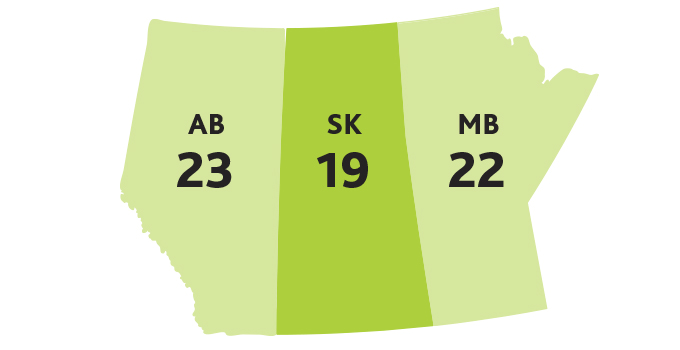
Source: Status of Herbicide Resistance in Canada
Making smart choices
To make effective applications that limit the spread of resistance, growers must match their tank mix partner to the crop they’re seeding and the weed they’re targeting.
Although Group 9-resistant kochia isn’t widespread in the Brooks region, Noga is working with growers to include products like Heat LQ (Group 14), Authority Charge (Group 14) and Brotex 480 (Group 6) in their pre-seed applications, which would be followed in-crop with a Group 6 bromoxynil or Group 4 fluroxypyr.
There are also newer products, like Conquer™, a pre-seed burndown for canola, which are allowing growers to diversify the active ingredients used on their farm.
“There are a lot of new chemistries coming out in the market and if you ignore a problem thinking, ‘That’s just a patch,’ it can get to be worse and more widespread and infest your entire farm and your neighbour’s farm,” said Noga.
“By working with us as the agronomists, we have a higher chance of catching that before it becomes a farm-wide problem and develop a strategy to manage it.”
Monsanto advises how to maximize early-season weed removal with pre-seed tank mixes in this original article by Jennifer Ewankiw, Monsanto’s Weed Management Solutions Marketing Manager.
For more information, please refer to the Saskatchewan Guide to Crop Protection and the Alberta Blue Book.

Certified Crop Advisor
South Country Co-op