



From insects, disease, weed pressure and herbicide carryover to soil fertility and weather, prairie growers have to account for a lot when making crop planning decisions. Co-op team members like Riley Schick, a Grow Team member with Palliser Plains Co-op, use a variety of tools to ensure his farm customers are armed with the right information.
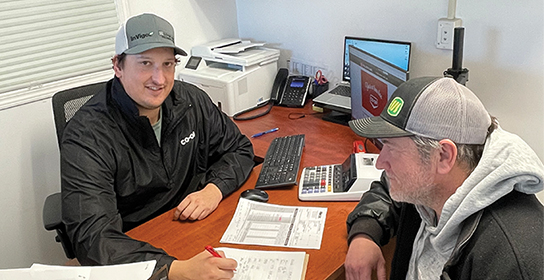
Schick is one of over 365 agronomists in Co-op’s Grow Team, a community of agronomy specialists who bring the latest crop production strategies and services to western Canadian farmers.
“Locally, we focus a lot of time and energy on controlling kochia, pulse crop diseases and insect monitoring—things of that nature,” said Schick. “We try to focus on the scientific reasoning of why things work or don’t work and be the liaison between those doing research in various fields of agriculture and those who actually have to put seeds in the ground.”
Schick himself is regularly on the ground, scouting a variety of crops for weeds, insects, disease and any unanticipated issues in his customers’ fields. He said growers in his area spend a lot of time and energy on killing kochia, preventing disease and managing insects. Grasshoppers have also been a particularly significant problem in recent years due to repeated dry growing seasons. The usual suspects of aphids in lentils and flea beetles in canola are also at the forefront.
Extended dry conditions have also resulted in significant nitrate carryover.
“There’s a lot of focus on soil sampling and picking the best rotation we can to take advantage of leftover nitrate. That’s picking the best ground for pulses, so they don’t have nodulation issues, but also taking note of possible herbicide carryover for crops that might be susceptible to that carryover,” he said.
“Planning can be a complicated process with so many crop protection products available to growers. What chemicals are applied in-season will affect where you put specific crops the following year. When you use residual products, you need to know exactly what crops are going to go where.”
“We try to help our customers be ahead of the game by placing those residuals in the proper places, so no one is shooting themselves in the foot the following year. By mid-October, you’ve chosen the correct crop for that piece of ground.”
With so much to keep track of, Schick finds AgZone FIELD, Co-op’s agronomy management software, a very useful tool. It helps keep all agronomic field data organized while allowing for easy information sharing between growers, agronomists and other agronomy software.
It allows Schick, his colleagues and customers to access NDVI field imagery, plus historical and current precipitation records for specific fields. Both help Schick stay on top of potential issues by, for example, knowing where to prioritize field scouting efforts, such as areas that may have grasshoppers moving in, hard-to-access spots and even hidden areas of salinity. Weather data can help with judging the severity of potential herbicide carryover and fungicide calls.
“I find AgZone easy to use and share information. I’ve done it other ways in the past, and I find the speed at which I can scout and relay data to growers quite useful. I can make maps and colour code everything to help them see what’s going on and stay organized,” said Schick. “The NDVI capability means I can get a different viewpoint of a field that may tell me something different than what I can see with the naked eye.”
Schick is eager for what else AgZone FIELD can help him get done. “In the future, I’m also planning on using the program to create personalized variable rate maps.”