


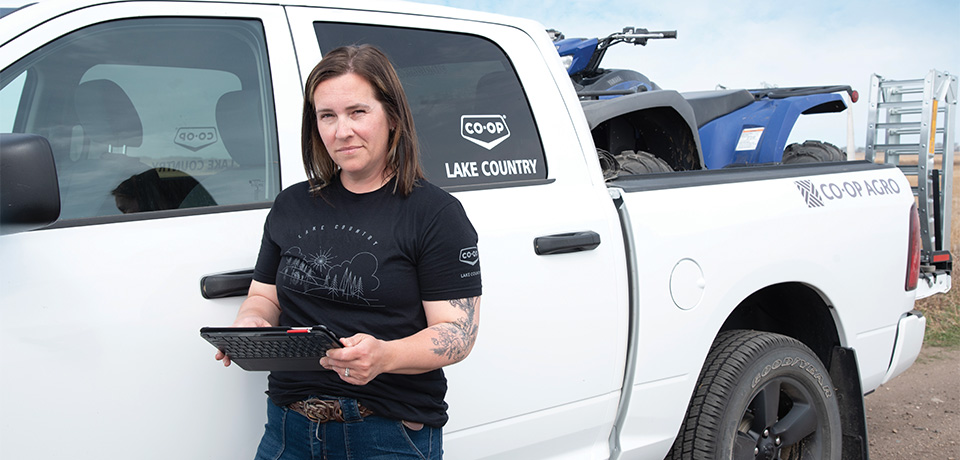
Co-op AgZone FIELD helps Grow Team members work with farmers like you to effectively plan next year’s crop by comparing current and past data, gathering soil sampling information and performing profitability analysis. The platform’s versatile tools and the Grow Team’s expertise are the definitive formula for the success of any growing operation.
AgZone FIELD Key Features
AgZone FIELD is one of the three Co-op AgZone digital solution pillars, along with BOOKS and YARD. FIELD collects and stores field data in one place for easy access and analysis. The centralized insights can be used as a foundation for creating optimal crop plans, increasing profitability and making informed real-time decisions.
The data that can be collected and stored in AgZone FIELD includes field specifications, crop history, yield analysis, soil sample results and herbicide application summaries. Having all this information in one place allows the Grow Team to better understand their clients’ fields and assist in more efficiently planning the next year’s operations.
AgZone FIELD helps farmers easily collaborate with Co-op agronomists and advisors. “I believe growers are starting to look for an easy-to-use cloud-based system to store all their data. No more books and papers lying around or multiple excel sheets. Grow Team members can show farmers AgZone FIELD with all the information in one spot,” said Kimberly Leblanc, Sales Agronomist at Lake Country Co-op.
Plan Next Year’s Crop
Effective planning relies on data. AgZone FIELD provides that data for Co-op’s Grow Team members to leverage with their expertise to help ensure a successful and profitable harvest for the next year.
Crop Plan Development
A crop plan is the foundation of a successful harvest and maximum profitability. Crop planning usually takes place during winter, when both farmers and agronomists have time to analyze past data and market trends to make the right decision for every acre.
The main focus of crop planning is rotation. The Grow Team considers the types of crops, weed infestations, diseases and applied products. “For example, if peas have been on the field within the last four years, I recommend not growing them for the next couple of seasons, as Aphanomyces has been a problem for the last 5–10 years,” said Leblanc.
Developing crop plans in AgZone FIELD means having all the key data in one place, easily accessible for both the grower and the agronomist. This helps Grow Team members forecast and schedule farm visits, suggest the right products and ultimately ensure an efficient and profitable operation.
Soil Sampling
Soil sampling helps build a picture of the nutrients left in the soil from the previous growing season and what needs to be added in the next season. Spring and fall are the main seasons for performing soil tests. Spring samplings are usually more accurate but have a limited window, since springs in Western Canada are pretty short. Fall sampling offers a more comfortable timeframe and helps gather enough data to analyze and plan in winter.
AgZone FIELD makes soil sampling much easier by digitizing and centralizing the data. “Before, it was a lot of paperwork to send samples to the lab. Now it’s all at your fingertips on your phone or tablet. The platform also has GPS locating tools that allow comparing samples from the same area over the years,” Leblanc said.
On top of collecting data in one place and simplifying sample planning with GPS, AgZone FIELD can generate soil bag labels, send the samples to the lab, and match the lab reports with the data inputs once they are ready.
Profitability Analysis
“With the current costs of all inputs, it’s nice to have the ability to see the farm as a whole to make sure you are making the most out of the acres available,” said Leblanc. “Farming is a business, and you need to make a profit to make it in the future.”
Farmers consider many factors when calculating profitability at year-end. The typical profitability formula subtracts all the spending per commodity, such as seed, applied products, labour, fuel, etc. from the revenue.
In AgZone FIELD, agronomists can input different crop plan variations to estimate the next season’s profits and determine the most optimal action plan. According to Leblanc, Grow Team advisors can filter the data by field or by commodity, so they can offer more precise solutions than traditional record-keeping methods offer, ensuring that your crop plans are built for success.
Supporting Local Growers: Co-op Grow Team
“We build trust and have all the products needed on the farm,” said Leblanc. Grow Team members are agronomy experts, ready to assist growers with soil sampling, record keeping, crop planning, budgeting, scouting, collecting all the necessary data and more.
To learn more about how to put AgZone FIELD to use on your farm, contact your local Grow Team member.