



Early season weed removal has been studied extensively as a means of increasing crop yield. Remove your weeds early and they no longer compete with your crop plants for limited soil, moisture and light resources.
While yield and profitability are often our No. 1 concerns, the use of early season weed removal is a key strategy to help manage the development of herbicide-resistant weed populations in your fields.
- MORE: Pre-seed applications that work
- MORE: Master your mix
Resistant weeds develop as a response to selection pressure that occurs when something negatively impacts the weed’s survival. Herbicides, tillage, hand-weeding and mowing are all examples of selection pressure that can alter weed populations.
How can we control weeds and limit our selection of resistant weeds?
Be unpredictable in your weed control. It takes time for weed populations to shift to tolerate selection pressure. If the selection pressure is always different, weeds have a more difficult time catching up, so growers are encouraged to apply herbicide combinations with multiple modes of action effective on the same weed species. The herbicide modes of action used should be rotated in and out of fields whenever possible. It’s important to utilize targeted herbicide applications containing multiple modes of action at different times of year to keep weed populations guessing when the next herbicide will be applied.
Weeds emerge all year long and are most easily controlled when small. However, spraying in-crop herbicides at roughly the same time each year can cause shifts in weed populations.
After several years of in-crop applications, your weed population will consist of more winter annual species (weeds that germinate in the fall, survive under the snow and grow again in the spring), as well as very early spring-emerging species and species that emerge after you have sprayed your in-crop herbicide.
To prevent these other species from becoming a major issue in your fields, vary the timing of your herbicide applications.
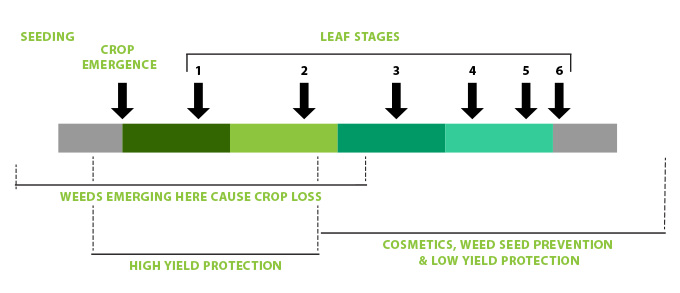
Control weeds early. Source: Neil Harker, AAFC
Removing weeds early – generally within two to three weeks of crop emergence - helps to protect yield. After this point, spraying herbicides is more for reducing seed return, dockage, and for cosmetic purposes (who likes seeing wild oat panicles towering above a maturing crop?). Sometimes we call these late spray applications “revenge spraying”. Once the crop is past a certain stage, removing weeds will have very little, if any, impact on yield.
Effective early season herbicide applications are an excellent way to control early germinating and winter annual weed species. Residual pre-emergent herbicide options can also offer weed control well into the growing season. When considering early season herbicides as a method to remove predictability from your weed management system, increase your crop’s yield potential and reduce resistant weed development, take a few of the following points into account:
Yield
- Removing weed competition early improves crop stand establishment and halts the loss of nutrients, moisture and sunlight to weed species. Peer-reviewed Canadian research has shown up to a 25-per-cent increase in yield of crops with early season weed removal.
Control
- Smaller weeds are more effectively controlled by herbicides. The surface area to total biomass ratio is generally higher for smaller weeds, meaning more herbicide can get into smaller weeds.
- Plant defence mechanisms against herbicides, such as thick waxy cuticles and small hairs, may not be fully developed.
- Herbicide is not intercepted by crop plants, meaning better coverage on the weeds in your field.
- Control of early germinating or over-wintering weeds reduces the chance of weed seeds going back into your field before harvest.
Resistance management
- At pre-seed/pre-emergent application timing, there will be fewer weeds in your field that are larger than the recommended herbicide label staging. This decreases the potential of weeds receiving a sub-lethal dose of herbicide. The same is true for in-crop applications after pre-seed/pre-emergent herbicides have been used, as fewer weeds will be present at in-crop application timing and those that are will be smaller.
- With no crop seeded you have more herbicide groups available to mix together to reduce the chance of resistance development. If you spray multiple herbicides that are effective on the same weed, an individual weed would have to be naturally resistant to both herbicides to survive. This creates a multiplying effect reducing the chance of herbicide resistance developing.
Cost effectiveness
- Pre-seed/pre-emergent herbicides are highly effective and often cost less than in-crop options.
- Controlling weeds early in the season results in fewer, smaller weeds present at in-crop herbicide timing. This can allow growers to get good efficacy out of a lower-cost in-crop herbicide combination.
- Residual pre-seed/pre-emergent herbicide options can reduce the frequency of required in-crop herbicide applications.
Be unpredictable and reduce herbicide resistance development. Herbicide-resistant weeds result in millions of dollars of extra costs for growers throughout North America, requiring additional herbicides and even hand-weeding.

Technical Services Manager - Western Canada
Nufarm Agriculture Inc.